Introduction
Every business owner wants to save money.
It's only natural.
When planning a new website, one of the first questions people ask is:
"Who can build it for the lowest price?"
At first glance, choosing the cheapest option seems like a smart business decision. After all, if two websites look similar, why spend more?
The reality is often very different.
A website isn't just a visual product, it's a long-term business asset. Behind every professional website are countless decisions involving architecture, security, performance, search engine optimization, scalability, user experience, and ongoing maintenance.
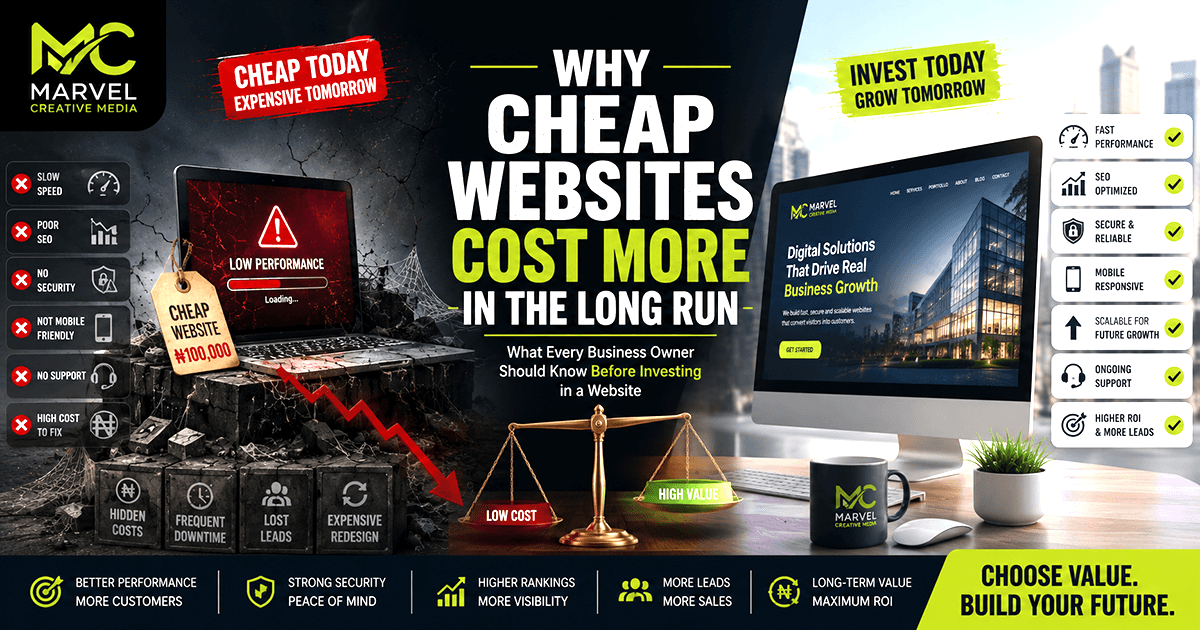
Unfortunately, many businesses discover too late that the cheapest website often becomes the most expensive one.
At Marvel Creative Media, we've worked with businesses that came to us after investing in low-cost websites that failed to generate leads, rank on Google, load quickly, or support future business growth. In many cases, the cost of fixing these issues exceeded what it would have cost to build the website properly from the beginning.
In this article, we'll explore why inexpensive websites often become costly mistakes and how investing in quality development can save your business time, money, and missed opportunities.
1. Cheap Websites Often Prioritize Price Over Strategy
A professional website begins long before a single line of code is written.
It starts with understanding:
Your business goals
Your target audience
Your competitors
Your customer journey
Your long-term growth plans
Low-cost website providers often skip this discovery phase entirely.
Instead, they rely on generic templates and quick deployment to reduce development time.
The result?
A website that may look acceptable but fails to support your business objectives.
A successful website should be designed around strategy, not speed alone.
2. Poor Performance Drives Customers Away
Website speed directly influences customer behavior.
Research consistently shows that visitors expect websites to load within just a few seconds. Slow websites increase bounce rates, reduce engagement, and negatively impact conversions.
Many inexpensive websites suffer from:
Unoptimized images
Bloated code
Poor hosting environments
Excessive plugins
Inefficient databases
These shortcuts may reduce development costs initially, but they create long-term performance problems that affect both user experience and search rankings.
A fast website isn't simply a technical achievement, it's a competitive advantage.
3. Weak SEO Means Fewer Customers
Even the most attractive website has little value if potential customers can't find it.
Professional SEO begins during development, not after launch.
A quality website should include:
Clean URL structures
Optimized metadata
Proper heading hierarchy
Mobile-first design
Structured data
XML sitemaps
Internal linking
Image optimization
Many budget websites ignore these essentials entirely.
As a result, businesses struggle to appear in Google search results, limiting their visibility and reducing opportunities for organic growth.
4. Security Should Never Be Optional
Cybersecurity is no longer reserved for large corporations.
Every business website is a potential target.
Unfortunately, low-cost projects often compromise security by:
Using outdated software
Ignoring secure coding practices
Skipping input validation
Lacking proper authentication
Omitting regular updates
These vulnerabilities can expose sensitive customer information, damage your reputation, and result in expensive recovery efforts.
Investing in security from the beginning is significantly more affordable than recovering from a security breach.
5. Scalability Is Often Forgotten
Businesses evolve.
Your website should evolve with them.
Today you may need:
Five service pages.
Next year you may want:
Online bookings.
Customer accounts.
E-commerce.
CRM integration.
Marketing automation.
AI-powered customer support.
Many inexpensive websites aren't built with future expansion in mind.
Adding new functionality later often requires extensive redevelopment, or a complete rebuild.
Scalable architecture protects your investment.
6. Hidden Costs Add Up Quickly
The advertised price rarely tells the full story.
Businesses often encounter additional costs for:
Content updates
Security fixes
Performance optimization
SEO improvements
Feature requests
Maintenance
Technical support
Website migration
A website that appeared affordable initially may become significantly more expensive over its lifetime.
Understanding the total cost of ownership is far more important than focusing solely on the initial quote.
7. Poor User Experience Costs Real Business
Visitors form opinions about your business within seconds.
An outdated or confusing website can create the impression that your business lacks professionalism.
Common user experience issues include:
Difficult navigation
Cluttered layouts
Slow loading pages
Broken forms
Poor mobile usability
Inconsistent branding
These problems don't just frustrate visitors, they reduce trust and discourage enquiries.
A great user experience encourages confidence and supports conversions.
8. Ongoing Support Matters
Launching your website is only the beginning.
Technology changes continuously.
Professional websites require:
Security updates
Performance monitoring
Software updates
Regular backups
Technical assistance
Feature enhancements
Many low-cost developers disappear once the project is delivered, leaving businesses without reliable support when problems arise.
A trusted development partner continues adding value long after launch.
9. Cheap Today Can Mean Expensive Tomorrow
One of the most common situations we see is businesses replacing websites that are only one or two years old.
Why?
Because the original website:
Doesn't generate leads.
Doesn't rank on Google.
Loads slowly.
Isn't secure.
Can't support new business requirements.
Instead of upgrading the existing website, the business ends up funding an entirely new project.
In many cases, the total cost of building two websites exceeds what a professionally developed website would have cost from the beginning.
10. Think Investment, Not Expense
A professional website should generate measurable business value.
It should help you:
Attract new customers.
Build credibility.
Improve visibility.
Increase enquiries.
Support marketing campaigns.
Strengthen your brand.
Grow revenue.
Viewed this way, a website isn't merely an expense.
It's one of your business's most valuable long-term investments.
Final Thought
Choosing the cheapest website may seem like a smart financial decision, but it's important to look beyond the initial price.
A professional website isn't simply about appearance, it's about performance, security, scalability, search visibility, and long-term business success.
Investing in quality development today reduces future expenses, strengthens your brand, and provides a digital platform capable of supporting your business for years to come.
When comparing website proposals, don't ask only:
"Which option costs less?"
Ask the more important question:
"Which option delivers the greatest long-term value for my business?"
The answer to that question will almost always lead to a better investment, and better business outcomes.