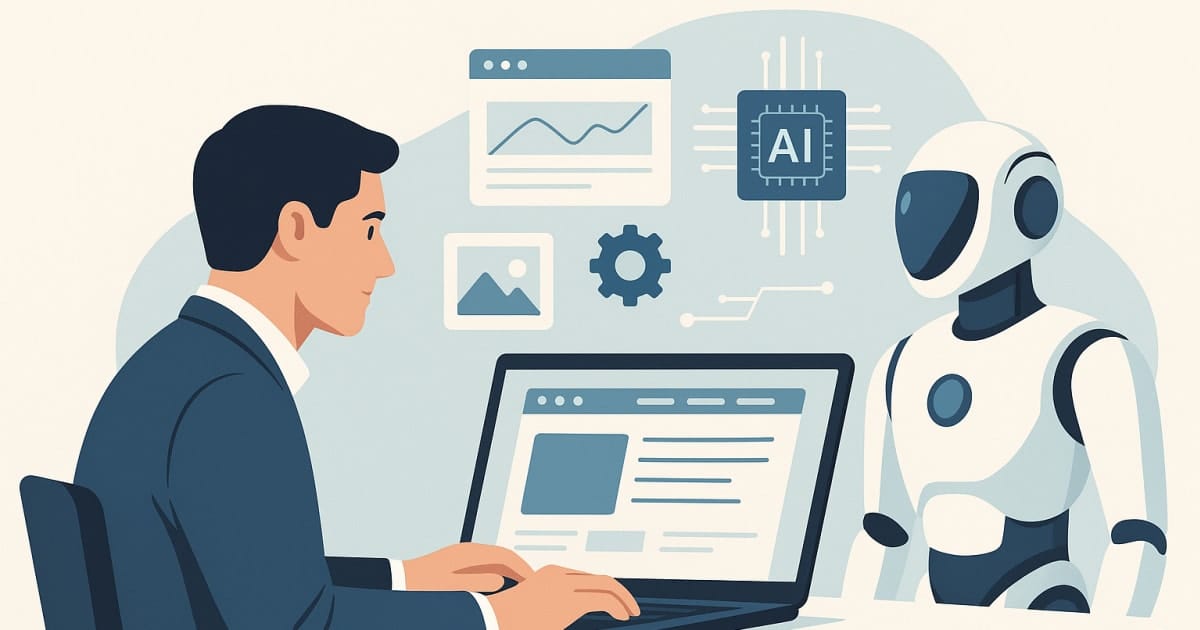
Artificial intelligence is reshaping the way businesses approach digital products, and websites are no exception. From content assistance and design support to code generation, testing, personalization, and performance analysis, AI website development is helping teams move faster and make more informed decisions.
For business owners and decision-makers, that creates both opportunity and confusion. Many organizations are asking the same questions:
Can AI help us launch faster?
Will it lower development costs?
Is AI-generated code production-ready?
Do we still need experienced developers and software engineers?
How can we use AI without compromising quality, security, or long-term scalability?
The short answer is this: AI is transforming custom website development, but it is not replacing the need for experienced technical teams. Instead, it is becoming a powerful layer within the modern web development process, enabling software engineers, designers, strategists, and content teams to work more efficiently while still relying on human expertise for architecture, security, quality control, and business alignment.
This guide explains how artificial intelligence web development is changing the industry, where AI delivers real value, where its limitations matter, and how businesses can use it strategically to build better digital experiences.
Why AI matters in modern website development
Business websites are no longer simple online brochures. They are expected to do much more:
represent the brand clearly
load quickly across devices
support SEO and content growth
integrate with business systems
protect user data
convert visitors into leads or customers
scale with changing business needs
Meeting those expectations requires more than a template and a few generated pages. It requires a thoughtful combination of design, engineering, infrastructure, content strategy, analytics, and ongoing optimization.
AI is influencing nearly every one of those areas.
In practical terms, AI can help teams:
speed up research and planning
automate repetitive development tasks
support AI web design workflows
generate code drafts and UI patterns
improve testing and debugging
personalize user experiences
enhance search and content discovery
analyze site performance and user behavior
That makes AI valuable. But value does not come from automation alone. It comes from using automation in the right places inside a well-managed delivery process.
What AI website development actually means
When people hear the term AI website development, they often think of tools that promise to build an entire website automatically. In reality, AI plays a broader and more nuanced role.
AI in web development can include:
AI-assisted planning and discovery
AI can help summarize market research, organize feature ideas, support content mapping, and accelerate early-stage planning. This can be especially useful for startups and fast-moving teams trying to define site structure and priorities.
AI-supported design workflows
Design teams can use AI to generate layout ideas, suggest UI directions, help create style variations, or speed up asset production. This is one reason AI web design has gained attention among agencies and in-house teams.
AI-assisted coding
Developers can use AI tools to draft components, boilerplate code, utility functions, tests, documentation, and integration patterns. This can increase productivity, particularly in modern frameworks used in Next.js development and other component-based ecosystems.
AI-driven content and personalization
AI can support dynamic messaging, recommendation engines, smarter search, and tailored user journeys based on behavior or audience segments.
AI for quality assurance and optimization
AI can help identify bugs, flag accessibility issues, surface performance concerns, detect unusual behavior patterns, and provide data-backed suggestions for improvement.
The most important point is that AI is not a single capability. It is a collection of tools and methods that can assist different stages of website strategy, design, engineering, and growth.
How AI is improving the custom website development process
The biggest impact of AI is often not that it replaces teams, but that it improves how teams work.
Faster prototyping and ideation
One of AI’s clearest benefits is speed. Development teams can create initial concepts, wireframes, code scaffolds, and content drafts more quickly than before. This shortens the time between idea and prototype.
For businesses, that can mean:
quicker validation of concepts
faster stakeholder feedback cycles
reduced time spent on repetitive setup tasks
earlier visibility into what the final product might become
In custom website development, this is especially useful during the early phases, when requirements are still being refined.
Better support for content-rich business websites
Many business websites rely on frequent content updates, landing pages, case studies, product pages, service pages, FAQs, and resource libraries. AI can support editorial planning, content structuring, metadata suggestions, and optimization workflows.
That said, content quality still depends on human review. Businesses should be careful not to equate AI-generated text with strong messaging, brand consistency, or SEO authority.
Improved personalization and user experience
Modern users expect digital experiences to feel relevant. AI can help businesses personalize website interactions based on factors such as:
visitor behavior
traffic source
location
interests
past interactions
product or service preferences
This can improve engagement and conversion rates when implemented responsibly. Examples include personalized homepage messaging, smart product recommendations, adaptive navigation, and contextual calls to action.
Smarter search and navigation
AI can improve how users find information on a website through semantic search, predictive search suggestions, and better content categorization. For organizations with large content libraries or complex service offerings, this can have a meaningful effect on usability.
More efficient testing and debugging
AI tools can help developers identify code issues, suggest fixes, create tests, and review implementation patterns. This can improve output quality and reduce time spent troubleshooting straightforward issues.
Still, the best outcomes happen when those suggestions are reviewed by experienced engineers who understand application logic, security implications, browser behavior, and infrastructure requirements.
Stronger performance insights
Performance matters for user experience, conversion, and visibility in search. AI can help surface trends in analytics data, identify content bottlenecks, and suggest optimization opportunities.
Combined with modern frameworks and disciplined engineering practices, those insights can support faster, more efficient sites.
Where AI adds the most value for modern businesses
Not every organization needs the same level of AI integration. The right approach depends on goals, internal capabilities, industry requirements, and website complexity.
Here are some of the most valuable use cases.
1. Accelerating early-stage website planning
For startups and growing businesses, AI can speed up sitemap planning, user journey analysis, feature prioritization, and competitor research synthesis.
2. Enhancing customer-facing experiences
AI-powered chat, guided search, recommendation systems, and dynamic content can help businesses improve customer engagement without adding unnecessary friction.
3. Supporting marketing and SEO operations
AI can assist with keyword clustering, content briefs, metadata generation, topic expansion, and internal linking suggestions. For marketing teams managing active content programs, this can improve efficiency.
4. Improving internal workflows for web teams
AI can reduce manual effort in development, QA, documentation, and analytics interpretation. This can allow teams to spend more time on strategic work.
5. Powering smarter, more scalable digital platforms
When used inside a strong technical foundation, AI can support advanced website features such as personalization engines, natural language search, predictive recommendations, automated workflows, and audience segmentation.
The limitations of AI in web development
AI is useful, but it has real limits. This is where many businesses need clarity.
AI does not understand your business goals on its own
A website should reflect business strategy, customer needs, sales priorities, market positioning, and operational realities. AI can assist with outputs, but it cannot independently define what success looks like for your organization.
AI-generated code is not automatically production-ready
Code suggestions may be incomplete, inefficient, insecure, outdated, or inconsistent with your architecture. They may also fail to account for edge cases, performance standards, accessibility requirements, or integration constraints.
This is a critical reason why software engineering expertise remains essential.
AI can introduce security and compliance risks
Modern websites often handle forms, user accounts, customer data, analytics, payment flows, and third-party integrations. Poorly reviewed AI-generated implementation can expose businesses to vulnerabilities or compliance problems.
AI can produce generic experiences
If businesses rely too heavily on AI without a clear brand strategy, they risk launching websites that feel interchangeable. A high-performing custom website should communicate a unique value proposition, not just functional completeness.
AI still requires human judgment
Technical decisions involve tradeoffs. Should a site be static, dynamic, or hybrid? Which framework best supports long-term growth? How should content models be structured? Which integrations are reliable? What performance budget should be enforced?
AI can assist with options, but experienced people must make the decisions.
Why experienced software engineers are still essential
As AI tools become more capable, the value of strong engineering often increases rather than decreases. That is because businesses still need people who can translate goals into durable, scalable solutions.
Architecture and scalability
A professional engineer designs systems that support long-term growth. That includes decisions around:
framework selection
data flow
API architecture
hosting and deployment
CMS implementation
caching strategy
maintainability
future extensibility
In custom website development artificial intelligence web development projects, these foundations matter far more than how quickly a first draft can be generated.
Security and risk management
Security cannot be treated as an afterthought. Experienced developers know how to evaluate dependencies, validate inputs, protect data, reduce attack surfaces, manage authentication, and follow secure implementation practices.
Performance optimization
Fast websites require more than clean-looking code. They require careful attention to rendering strategy, image optimization, script loading, caching, content delivery, and front-end performance patterns.
Accessibility and standards compliance
Professional teams know how to build websites that are accessible, usable, and aligned with web standards. That matters for audience reach, brand reputation, and in some cases legal risk.
Business alignment
Perhaps most importantly, experienced engineers understand that a website is not just a technical asset. It is a business tool. The best development teams build around outcomes such as lead generation, sales support, user retention, operational efficiency, and content scalability.
AI and Next.js development: a strong combination for modern websites
For many modern web projects, Next.js development offers a strong technical foundation. Next.js supports performance-focused, scalable web applications through features such as server-side rendering, static generation, hybrid rendering models, API routes, and a strong developer ecosystem.
When AI is added to the process, the combination can be especially effective.
Where AI helps in Next.js workflows
AI can assist developers with:
component scaffolding
route structure planning
metadata and schema suggestions
content model mapping
test generation
debugging support
documentation and refactoring
Where engineers still lead
Experienced engineers are still needed to manage:
application architecture
rendering strategy decisions
CMS and API integrations
performance tuning
security implementation
deployment and infrastructure
analytics and event tracking
Businesses considering modern rebuilds or performance-focused redesigns should think beyond visual design. The real value often comes from pairing a strong framework with thoughtful engineering and responsible AI-enabled workflows.
How AI is changing the roles of designers, developers, and marketers
AI is not removing the need for specialists. It is changing how specialists work.
Designers
Designers can use AI to accelerate concept generation and repetitive production tasks, but they still lead brand interpretation, visual hierarchy, usability, and experience design.
Developers
Developers can move faster with AI-assisted coding and testing, but they remain responsible for implementation quality, architecture, security, and maintainability.
Marketers
Marketers can use AI for research, content operations, personalization, and analysis, but they still shape messaging, audience strategy, positioning, and campaign alignment.
The most effective teams are not replacing people with AI. They are increasing the capabilities of people with AI.
What businesses should look for in an AI-powered website partner
If you are evaluating agencies or development partners, it is important to look beyond whether they “use AI.” That alone is not a differentiator anymore.
Instead, ask whether they can connect AI to real business outcomes.
Look for strategic thinking
A strong partner should understand your audience, revenue model, sales process, content needs, and growth goals before recommending tools or features.
Look for real engineering capability
AI can generate code, but it cannot replace a disciplined development process. Make sure your partner has demonstrated expertise in software engineering, modern frameworks, integrations, security, and performance.
Look for experience with scalable business websites
The needs of business websites are different from personal sites or simple templates. Look for a team that knows how to build platforms that support lead generation, SEO growth, operations, and future expansion.
Look for thoughtful use of AI
The best teams use AI intentionally, not excessively. They know when automation adds speed and when human review is non-negotiable.
Look for measurable outcomes
A quality development partner should be able to discuss performance, maintainability, user experience, SEO readiness, conversion goals, and long-term support.
Practical ways to adopt AI in website development without losing quality
Businesses do not need to overhaul everything at once. A practical adoption strategy often works best.
Start with workflow improvements
Use AI to support planning, drafting, QA, and analytics interpretation before moving into more complex customer-facing features.
Keep human review in place
Every AI-assisted output, especially code and customer-facing content, should be reviewed by experienced professionals.
Build on a strong technical foundation
AI features perform best when the underlying site is fast, organized, secure, and scalable.
Prioritize high-impact use cases
Focus first on the areas where AI can clearly improve efficiency or user experience, such as smarter search, better content workflows, or faster development operations.
Measure outcomes
Track whether AI-supported improvements actually affect performance, lead quality, engagement, or internal efficiency. Adoption should be tied to results, not novelty.
The future of AI website development
AI will continue to influence how websites are planned, built, and optimized. Tools will become more integrated into design platforms, development environments, analytics systems, and content operations.
We can expect continued progress in areas such as:
faster prototyping and development support
better personalization and user targeting
smarter search and navigation
more advanced automation in testing and QA
improved accessibility support
tighter integration between content, analytics, and customer data
But the core truth is unlikely to change: successful websites will still depend on clear strategy, sound architecture, secure implementation, and an understanding of real business goals.
AI can accelerate the path. It cannot define the destination.
Conclusion
AI website development is transforming the web industry in meaningful ways. It is helping teams move faster, automate repetitive work, improve personalization, and uncover new opportunities for optimization. For modern organizations, that opens the door to smarter and more responsive digital experiences.
At the same time, AI is not a substitute for experienced professionals. Building effective websites still requires strong software engineering, business understanding, strategic planning, and careful execution. The businesses that benefit most from AI will be the ones that use it as a force multiplier, not as a replacement for expertise.
For companies investing in custom website development, the goal should not be to ask whether AI can build a website on its own. The better question is how AI can support a skilled team in creating a website that is scalable, secure, high-performing, and aligned with business outcomes.
Looking to build a modern, AI-powered, high-performing website for your business? Marvel Creative Media specializes in custom website development that combines artificial intelligence with expert software engineering to deliver scalable, secure, and results-driven digital solutions. Contact us today to start your project.