Introduction
Your website is one of your business's most valuable digital assets. It works around the clock, represents your brand, answers customer questions, generates leads, and often creates the first impression potential clients have of your business.
But here's the reality:
A website that was excellent three or four years ago may no longer meet today's standards.
Technology evolves rapidly. Customer expectations change. Search engines update their ranking algorithms. Security threats become more sophisticated. What once helped your business grow can gradually become the very thing holding it back.
Many business owners don't realize their website has become outdated until they notice declining enquiries, falling Google rankings, or competitors consistently outperforming them online.
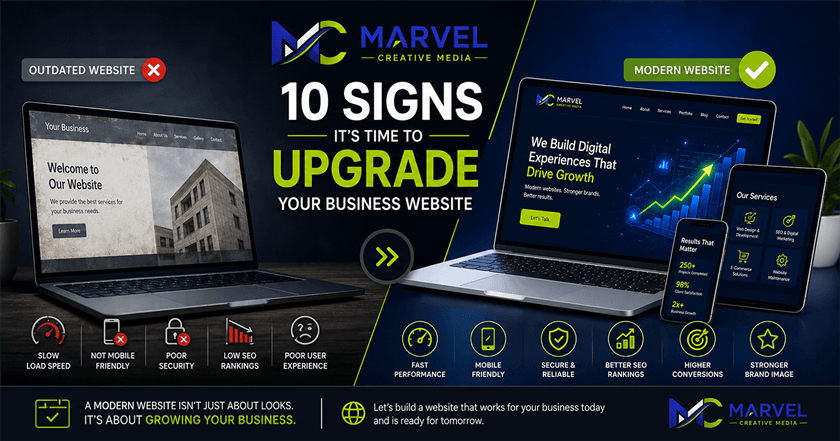
If you've ever wondered whether it's time for an upgrade, here are ten clear signs that your website may have outgrown its current state.
1. Your Website Looks Outdated
Visitors form an opinion about your business within seconds of landing on your website.
If your design feels old, cluttered, or inconsistent with today's standards, potential customers may assume your products or services are outdated too.
An outdated website often includes:
Old design trends
Poor typography
Low-quality images
Inconsistent branding
Crowded layouts
Your website should communicate professionalism, credibility, and trust from the very first visit.
2. It Doesn't Perform Well on Mobile Devices
Today, most website visitors browse using smartphones.
If users have to zoom, scroll sideways, or struggle to navigate your pages, they'll likely leave before taking any action.
A modern business website should provide:
Responsive layouts
Fast mobile loading
Easy navigation
Touch-friendly buttons
Readable text on every screen size
Google also prioritizes mobile-friendly websites in search results, making mobile optimization essential for both user experience and SEO.
3. Your Website Loads Slowly
Speed has become one of the most important factors in digital success.
Even a delay of a few seconds can lead to:
Higher bounce rates
Lower customer satisfaction
Reduced conversions
Lower Google rankings
Slow websites are often caused by:
Unoptimized images
Poor hosting
Outdated code
Too many unnecessary plugins
Inefficient databases
A faster website creates a better experience for both visitors and search engines.
4. You're Not Getting Leads or Enquiries
A website isn't successful simply because it's online.
Its primary purpose is to help your business grow.
If visitors aren't:
Contacting you
Requesting quotations
Booking consultations
Purchasing products
Subscribing to your newsletter
then your website isn't converting traffic into business opportunities.
Good design attracts visitors.
Great strategy converts them.
5. Your Website Is Difficult to Update
Many older websites require a developer to make even the smallest content changes.
Need to publish a blog?
Update a service?
Change a phone number?
Replace an image?
If every update becomes a technical project, your website is limiting your business instead of supporting it.
Modern content management systems make updates simple, efficient, and accessible.
6. Your Google Visibility Is Declining
Search engine optimization isn't something you do once and forget.
Search algorithms evolve continuously.
If your website:
Isn't appearing in search results
Receives little organic traffic
Has declining impressions
Isn't being indexed properly
your competitors are likely capturing customers who should be finding you instead.
Modern websites are built with technical SEO at their core, making them easier for search engines to crawl, understand, and rank.
7. It Can't Support New Features
Businesses grow.
Your website should grow with them.
Maybe you now want to add:
Online payments
Customer portals
Booking systems
Live chat
CRM integration
Email automation
Analytics dashboards
AI-powered tools
If your current platform struggles to support these features, it's a strong sign that the underlying architecture has reached its limits.
8. Security Has Become a Concern
Cybersecurity threats continue to evolve.
Older websites often run outdated software, unsupported plugins, or weak authentication systems, making them attractive targets for attackers.
A modern website should include:
HTTPS encryption
Secure authentication
Input validation
Regular updates
Secure hosting
Backup strategies
Spam protection
Protecting customer data isn't optional, it's essential.
9. Your Competitors Have Moved Ahead
Take a moment to compare your website with those of your leading competitors.
Ask yourself:
Which site looks more professional?
Which loads faster?
Which is easier to navigate?
Which communicates trust more effectively?
Which would you choose as a customer?
If your competitors consistently offer a better digital experience, they may also be winning customers who could have chosen your business.
10. Your Website No Longer Reflects Your Business
Businesses evolve.
Services expand.
Brand identities mature.
Markets change.
Yet many websites remain frozen in time.
Perhaps you've introduced new services, refreshed your branding, expanded into new markets, or changed your business strategy, but your website still tells yesterday's story.
Your website should accurately represent who your business is today, not who it was years ago.
What Happens If You Ignore These Signs?
Ignoring an outdated website can gradually impact your business in ways that aren't always obvious at first.
You may experience:
Fewer enquiries
Lower search rankings
Reduced customer trust
Poor conversion rates
Higher maintenance costs
Security vulnerabilities
Lost revenue
Missed business opportunities
Often, businesses don't realize the true cost of an outdated website until they compare it with the results a modern platform can deliver.
How to Plan a Successful Website Upgrade
Upgrading your website isn't just about giving it a new look.
A successful upgrade should focus on:
Modern design
Faster performance
Better SEO
Stronger security
Improved user experience
Easier content management
Scalable architecture
Future-ready integrations
When approached strategically, a website upgrade becomes an investment in your business's long-term growth, not just another expense.
Conclusion
Your website should evolve as your business evolves.
If several of the signs in this article sound familiar, it may be time to rethink your digital presence.
A modern business website isn't just a place where customers find information. It's a powerful platform that builds trust, attracts qualified leads, supports marketing efforts, and helps your business grow.
Technology continues to change, customer expectations continue to rise, and competition becomes stronger every year.
The businesses that succeed aren't always the biggest, they're the ones willing to adapt.
If your website is no longer helping your business move forward, perhaps it's time to build one that will.