Introduction
Technology evolves rapidly, and so do the expectations of businesses and users. A few years ago, having a responsive website with a reliable backend was enough to establish a professional online presence. Today, businesses expect much more.
They need fast-loading websites, seamless user experiences, secure data handling, powerful content management, excellent search engine visibility, and a foundation that can grow alongside their ambitions.
As our vision for Marvel Creative Media expanded, it became clear that our existing platform, while dependable, could no longer support the level of innovation, scalability, and flexibility we wanted to deliver.
Rather than making small incremental improvements, we made a much bigger decision.
We rebuilt the platform from the ground up.
This wasn't simply a migration from one technology stack to another. It was a complete architectural transformation designed to create a faster, smarter, more secure, and future-ready digital platform.
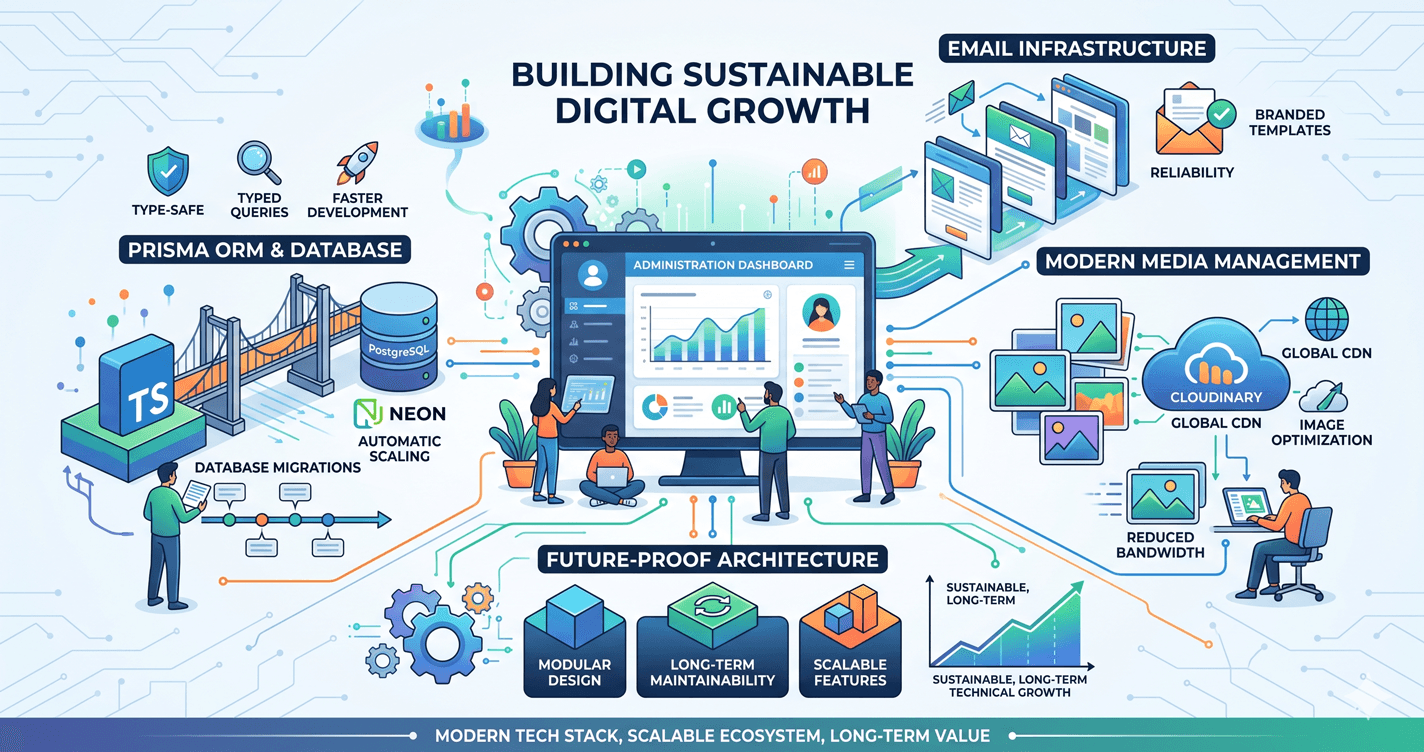
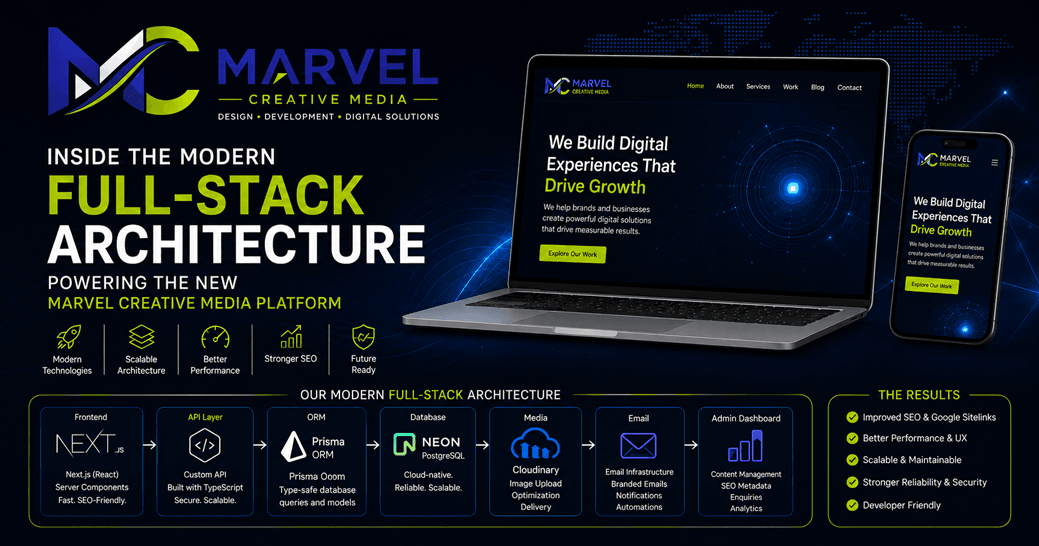
Today, the Marvel Creative Media platform is powered by a modern full-stack architecture built with:
Next.js
TypeScript
Prisma ORM
Neon PostgreSQL
Cloudinary
Vercel
Modern Email Infrastructure
Advanced SEO Architecture
A fully customized Administration Dashboard
Each technology was selected not because it was trendy, but because it solved real engineering problems and created a stronger foundation for long-term growth.
This article shares the journey behind that transformation, the lessons we learned, and why investing in modern architecture matters for businesses that want technology to support growth instead of limiting it.
Why We Decided to Rebuild Instead of Continuing to Patch
Every software platform reaches a point where adding new features becomes increasingly difficult.
The original Marvel Creative Media website performed well for its intended purpose. It successfully represented the business online and served clients effectively. However, as we began introducing more advanced features, we realized we were spending more time working around architectural limitations than building new capabilities.
We wanted more than just a beautiful website.
We wanted a digital platform capable of supporting future products, business automation, advanced SEO, content marketing, customer engagement, and long-term scalability.
The questions we began asking ourselves included:
How can we publish content more efficiently?
How can we improve Google visibility?
How can we simplify administration?
How can we create a better experience for clients?
How can we build features that continue to scale without constant rewrites?
Answering those questions required more than updating a few pages.
It required rethinking the architecture itself.
Why We Chose Next.js
The frontend is the first thing visitors experience, so performance and usability were top priorities.
After evaluating several modern frameworks, Next.js stood out because it combines developer productivity with exceptional user experience.
Some of the key advantages include:
Lightning-fast page rendering
Built-in image optimization
Excellent SEO capabilities
Server-side rendering and static generation
Intelligent routing
Automatic code splitting
Smooth deployment through Vercel
These features allow pages to load quickly while providing search engines with well-structured content that's easier to crawl and index.
For visitors, the difference is immediate.
Pages feel faster.
Navigation feels smoother.
The overall browsing experience becomes more professional and engaging.
Performance is no longer a luxury; it's part of the user experience.
Why TypeScript Became One of Our Best Decisions
One of the biggest improvements in the new platform was adopting TypeScript across the project.
While JavaScript offers incredible flexibility, that flexibility can become a disadvantage as projects grow larger.
TypeScript introduced something every growing application needs: confidence.
Instead of discovering errors after deployment, many potential issues are identified during development.
Some of the biggest benefits we've experienced include:
Stronger type safety
Improved code quality
Better IntelliSense and auto-completion
Easier refactoring
More reliable APIs
Improved collaboration
Reduced debugging time
Migrating wasn't always easy.
There were hundreds of type errors to resolve, functions to restructure, and interfaces to define.
However, every challenge strengthened the project.
Today, making changes is significantly safer because the compiler helps identify issues before they become production problems.
That's one of the biggest long-term advantages of investing in modern tooling.