Introduction
For many businesses, launching a website feels like crossing the finish line.
The website goes live, the excitement builds, and then... nothing.
Weeks turn into months, yet enquiries remain scarce. Contact forms stay empty. Sales don't improve. Website traffic may even exist, but visitors leave without taking action.
If this sounds familiar, you're not alone.
One of the biggest misconceptions in digital marketing is believing that simply having a website is enough to generate customers. The truth is, a website is only as effective as the strategy, technology, and user experience behind it.
A high-performing business website should do much more than look attractive. It should build trust, answer customer questions, encourage action, and consistently generate qualified leads.
So why isn't your website doing that?
Let's explore the most common reasons and, more importantly, how to fix them.
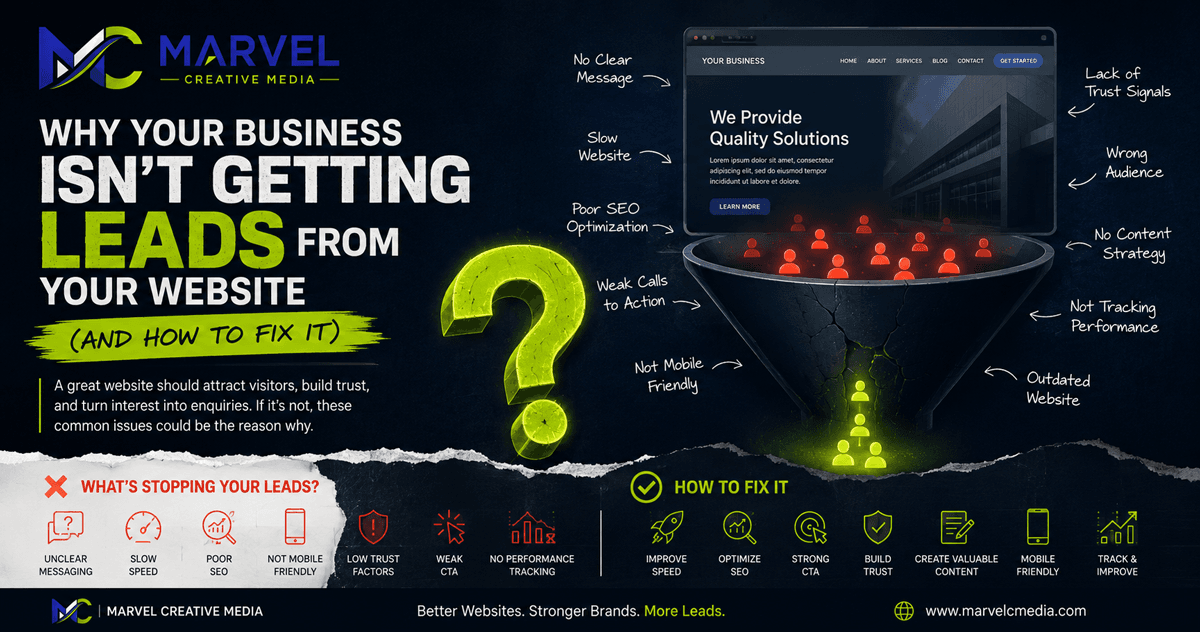
1. Your Value Proposition Isn't Clear
When visitors arrive on your homepage, they should immediately understand three things:
What your business does
Who it's for
Why they should choose you
If users spend more than a few seconds trying to figure this out, many will simply leave.
Clear messaging creates confidence.
Instead of using vague phrases like "We provide quality solutions," explain exactly how you solve customer problems and what makes your business different.
Remember: visitors don't stay because your website is beautiful, they stay because they quickly see value.
2. Your Website Loads Too Slowly
Speed directly affects conversions.
Research consistently shows that users abandon websites that take too long to load.
Slow websites usually suffer from problems such as:
Large, unoptimized images
Poor hosting infrastructure
Outdated code
Excessive plugins or scripts
Inefficient databases
A faster website not only improves user experience but also helps your search engine rankings.
Every second matters.
3. Visitors Don't Know What Action to Take
Imagine walking into a store where nobody greets you or tells you where to go.
That's exactly what happens on websites without clear Calls-to-Action (CTAs).
Every important page should guide visitors toward the next step.
Examples include:
Request a Quote
Book a Consultation
Contact Us Today
Download Our Free Guide
Get Started
Without direction, visitors often leave, even if they're interested in your services.
Good websites don't leave decisions to chance.
4. Your Website Isn't Optimized for Search Engines
Even the most beautiful website can't generate leads if nobody can find it.
Search Engine Optimization (SEO) helps your website appear when potential customers search for products or services like yours.
Common SEO problems include:
Missing meta titles and descriptions
Poor keyword targeting
Weak internal linking
Thin content
Duplicate pages
Poor heading structure
Slow performance
A strong SEO strategy allows your business to attract visitors who are already looking for what you offer.
That's qualified traffic and qualified traffic converts better.
5. Your Website Doesn't Build Trust
Before contacting your business, visitors subconsciously ask themselves one important question:
"Can I trust this company?"
Your website should answer that question immediately.
Trust can be strengthened by including:
Client testimonials
Portfolio or case studies
Professional branding
Clear contact information
Business location
Certifications
Frequently Asked Questions
Secure HTTPS connection
Small trust signals often make the difference between a visitor leaving and becoming a customer.
6. Your Website Isn't Mobile-Friendly
Today, the majority of visitors browse websites using smartphones.
If your website isn't responsive, users may experience:
Tiny text
Broken layouts
Difficult navigation
Slow loading
Poor usability
Google also prioritizes mobile-friendly websites in search results.
A modern website should deliver an excellent experience regardless of screen size.
7. You're Attracting the Wrong Audience
Sometimes the problem isn't the website itself.
It's the audience you're attracting.
If your content targets the wrong keywords or speaks to the wrong customer, you'll receive visitors who were never likely to become clients.
Effective websites combine:
Strong SEO
Helpful content
Clear positioning
Well-defined target audiences
The goal isn't more traffic.
The goal is better traffic.
8. Your Website Doesn't Educate Visitors
Modern buyers research before making decisions.
If your website contains only service pages, you're missing an opportunity to build authority.
A regularly updated blog helps businesses:
Answer customer questions
Improve SEO
Demonstrate expertise
Build trust
Increase organic traffic
Educational content turns your website into a valuable resource rather than just an online brochure.
9. You're Not Measuring Performance
You can't improve what you don't measure.
Many businesses never check:
Where visitors come from
Which pages perform best
Where users leave the site
Which pages generate enquiries
Which marketing campaigns convert
Tools like Google Analytics, Google Search Console, and heatmaps provide valuable insights that help you make smarter decisions.
Data removes guesswork.
10. Your Website Hasn't Evolved With Your Business
Businesses grow.
Services change.
Customer expectations evolve.
Technology advances.
Yet many websites remain exactly as they were years ago.
An outdated website can quietly limit growth by failing to reflect your current capabilities, brand identity, and business goals.
Your website should evolve alongside your business, not hold it back.
How to Turn Your Website into a Lead-Generating Machine
If your website isn't producing results, don't panic.
Most problems can be solved with the right strategy.
Start by focusing on these essentials:
Improve page speed.
Strengthen your SEO.
Clarify your messaging.
Add compelling Calls-to-Action.
Build trust with testimonials and case studies.
Publish valuable blog content regularly.
Ensure mobile responsiveness.
Monitor performance with analytics.
Prioritize website security.
Continuously improve based on user behavior.
Small improvements made consistently often produce remarkable long-term results.
Final Thoughts
A website shouldn't simply exist online; it should actively contribute to your business growth.
The most successful business websites don't rely on luck. They're built with purpose, optimized for search engines, designed around user experience, and continually improved over time.
If your website isn't generating the leads you expected, it doesn't necessarily mean your business has a problem.
It may simply mean your website isn't working as hard as it should.
With the right strategy, technology, and ongoing optimization, your website can become one of your most valuable business assets, attracting qualified visitors, building trust, and converting opportunities into long-term customers.
In today's competitive digital landscape, your website shouldn't just represent your business.
It should help grow it.