Building for Search Engines, Not Just Users
One of the biggest goals of this rebuild wasn't simply to create a faster website, it was to build a platform that search engines could understand more effectively.
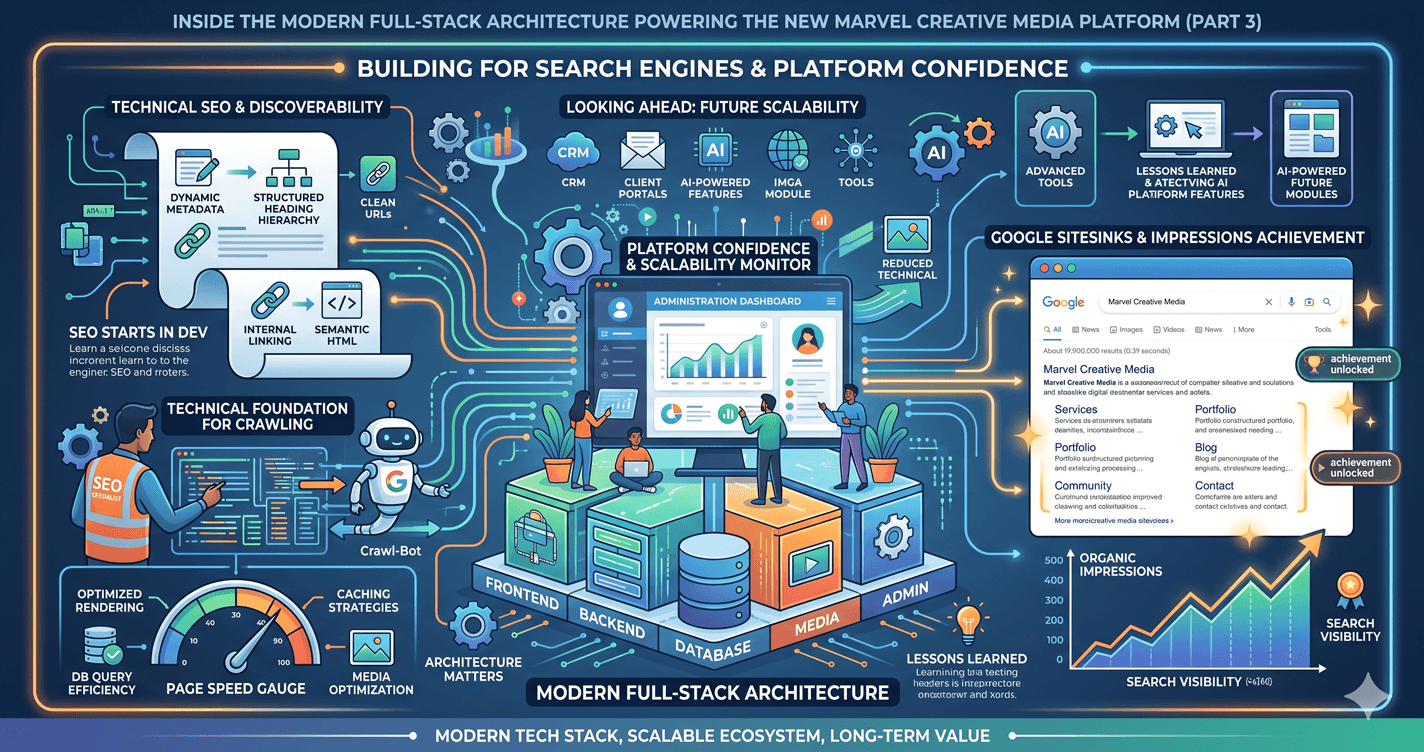
Search Engine Optimization (SEO) isn't something that should be added after development. It should be part of the architecture from the very beginning.
As we rebuilt Marvel Creative Media, every page, component, and content structure was designed with discoverability in mind.
Some of the SEO improvements include:
Dynamic metadata management
Optimized page titles and descriptions
Structured heading hierarchy
Clean, human-friendly URLs
Improved internal linking
Optimized image handling
Better semantic HTML
Faster page rendering
Search-engine-friendly architecture
These improvements created a much stronger technical foundation for search engines to crawl and understand our content.
One of Our Biggest Achievements: Google Finally Started Paying Attention
One of the most rewarding moments during this project happened several weeks after deployment.
Google began indexing our pages more consistently.
Search visibility improved.
Organic impressions increased.
Then something even more exciting happened.
Marvel Creative Media started receiving Google sitelinks beneath its primary search result.
For many businesses, this may seem like a small detail.
For us, it represented months of architectural improvements finally being recognized.
Sitelinks are often generated when Google has a high level of confidence in a website's structure, navigation, and content organization.
Seeing those additional links appear confirmed that the effort invested in rebuilding the platform wasn't just improving the user experience—it was also improving how search engines understood the website.
It was a significant milestone in our digital transformation journey.
Performance Improvements Across the Platform
Every decision made during development was guided by one simple objective:
Deliver a faster experience.
Performance improvements can be felt throughout the platform.
Pages render more quickly.
Navigation feels smoother.
Images load more efficiently.
Content appears almost instantly.
This was achieved through several improvements working together:
Optimized frontend rendering
Modern caching strategies
Efficient database queries
Cloud-based media delivery
Automatic image optimization
Reduced JavaScript overhead
Improved component architecture
Rather than relying on one optimization, we improved performance across every layer of the application.
The result is a website that feels faster, more responsive, and more enjoyable to use.
The Challenges Behind the Transformation
Every successful software project has a story that users never see.
Behind every polished interface are countless hours spent debugging, refactoring, testing, and learning.
Our migration presented several challenges:
Refactoring large portions of existing code
Resolving hundreds of TypeScript type issues
Migrating database structures
Rebuilding API integrations
Improving media handling
Redesigning administrative workflows
Modernizing email systems
Maintaining compatibility while introducing new technologies
There were moments when a single issue took hours—or even days, to solve.
But each challenge strengthened the platform.
Instead of looking for shortcuts, we focused on building solutions that would continue serving the business for years to come.
The experience reinforced an important lesson:
Great software isn't created by avoiding problems.
It's created by solving them properly.
Lessons We Learned
This transformation taught us lessons that extend far beyond technology.
Architecture Matters
The quality of a system is determined long before users see the interface.
Strong architecture creates flexibility, maintainability, and long-term stability.
Modern Tools Improve Confidence
TypeScript, Prisma, and modern deployment workflows didn't simply make development faster.
They made every future improvement safer.
SEO Starts During Development
Technical SEO is not a marketing task.
It's an engineering responsibility.
Building with SEO in mind from day one produced significantly better long-term results.
Continuous Improvement Wins
Technology never stands still.
The most valuable platforms are those designed to evolve continuously rather than remain unchanged.
Looking Ahead
Although this rebuild represents a major milestone, we see it as the beginning rather than the destination.
Our roadmap includes expanding the platform with additional capabilities, including:
Advanced CRM functionality
Client portals
Project management tools
Intelligent automation
Enhanced analytics dashboards
AI-powered business features
Improved content management workflows
Even stronger SEO capabilities
Because the new architecture was designed for scalability, adding these features will be far easier than before.
The foundation is already in place.
Now it's time to build on it.
Conclusion
Rebuilding the Marvel Creative Media platform was never about adopting newer technologies simply because they were available.
It was about creating a digital foundation capable of supporting long-term growth, better performance, stronger security, and a superior experience for both users and administrators.
Every decision, from adopting Next.js and TypeScript to implementing Prisma ORM, Neon PostgreSQL, Cloudinary, and a custom administration dashboard was driven by a single goal:
To build a platform that doesn't just meet today's needs but is prepared for tomorrow's opportunities.
The improvements we've already seen, in performance, maintainability, search visibility, and operational efficiency, have validated that decision.
But perhaps the biggest achievement isn't the technologies themselves.
It's the confidence that comes from knowing the platform is built on a solid, scalable foundation.
At Marvel Creative Media, we believe technology should do more than power websites.
It should empower businesses to grow, adapt, and innovate.
This transformation reflects that philosophy, and it's only the beginning of what we're building next.