In 2026, software decisions are no longer just operational choices. They are strategic business decisions that influence efficiency, scalability, customer experience, security, and long-term competitiveness.
For growing companies, one question comes up repeatedly: should you adopt a ready-made SaaS platform or invest in custom software development?
The answer depends on what your business is trying to achieve. A SaaS product can help you move quickly, lower upfront costs, and standardize common workflows. A custom-built platform can give you greater flexibility, tighter process alignment, stronger differentiation, and more control over your technology roadmap.
Neither option is universally better. The right choice depends on your growth stage, budget, internal capabilities, compliance obligations, and tolerance for vendor dependency. For many organizations, the most effective path may even include both.
This article breaks down custom software vs SaaS in practical terms, explains the advantages and limitations of each, and helps decision-makers evaluate which model delivers the most value for their business in 2026.
What Is SaaS?
Software-as-a-Service, or SaaS, refers to cloud-based software delivered by a third-party provider on a subscription basis. Users typically access the product through a web browser or app, while the vendor manages hosting, maintenance, updates, and core infrastructure.
Common examples include CRM systems, accounting platforms, project management tools, help desk systems, HR platforms, and marketing automation software.
Key characteristics of SaaS
Subscription-based pricing, often monthly or annual
Fast deployment with minimal setup
Standardized features designed for broad market use
Vendor-managed updates, support, and security operations
Limited control over core architecture and product direction
SaaS is often attractive to growing businesses because it reduces implementation friction. Instead of building a system from scratch, companies can adopt a proven platform and begin using it quickly.
What Is Custom Software?
Custom software is software designed and built specifically for the needs of a particular business. It may support internal operations, customer-facing experiences, partner portals, data workflows, or highly specialized industry requirements.
Unlike off-the-shelf SaaS, bespoke software is created around your processes, goals, integrations, and competitive priorities. It can be built by an internal team or through an external enterprise software development partner.
Key characteristics of custom software
Designed for your exact workflows and business logic
Flexible architecture tailored to your growth plans
Full or shared ownership of the product and roadmap
Integration with legacy systems, third-party tools, and proprietary data environments
Higher initial investment and longer implementation timeline than typical SaaS
Custom software development is often pursued when existing tools create bottlenecks, force workarounds, or limit a company’s ability to scale effectively.
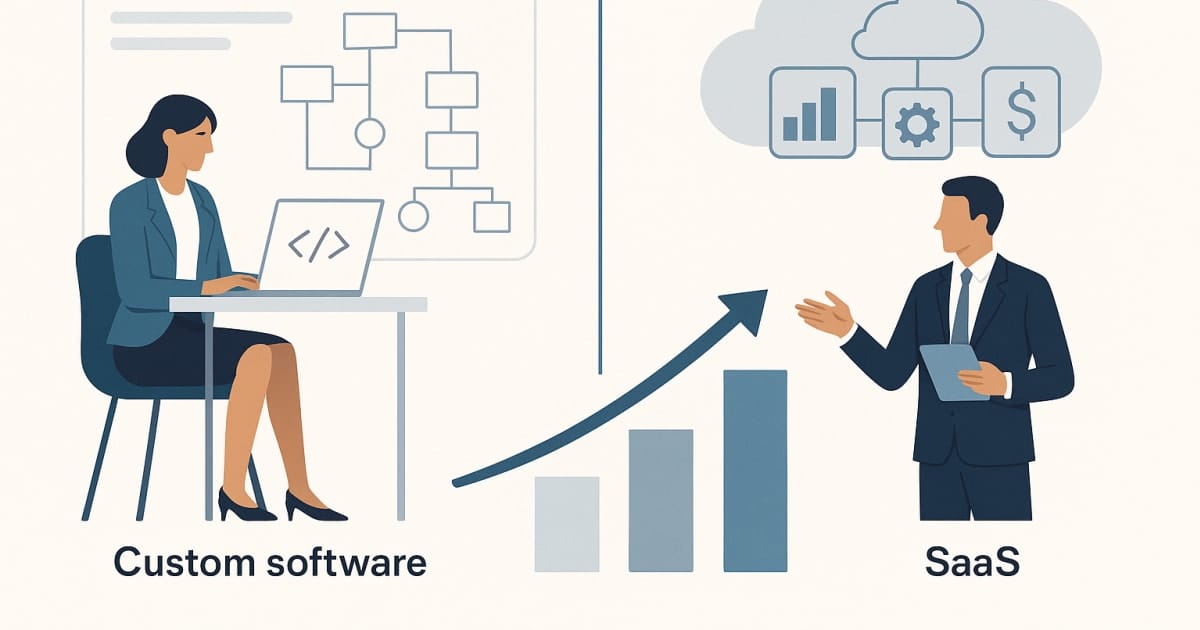
Custom Software vs SaaS: The Core Difference
At the highest level, the difference is simple.
SaaS gives you a standardized solution built for many customers.
Custom software gives you a tailored solution built for your business.
That distinction affects nearly every major decision area, including cost, speed, flexibility, control, security, scalability, and long-term value.
Comparing Custom Software and SaaS Across Key Business Factors
Speed to Deployment
For businesses that need to solve a problem quickly, SaaS usually wins.
A SaaS platform can often be configured and rolled out in days or weeks, depending on complexity. This makes it ideal when you need immediate functionality for common business needs such as invoicing, task management, CRM, collaboration, or payroll.
Custom software development takes longer because it involves discovery, planning, design, development, testing, deployment, and refinement. The payoff is that the final product is built around your needs rather than adapted from a generic template.
Best fit
Choose SaaS when speed is critical and the use case is relatively standard.
Choose custom software when the problem is strategic, complex, or central to your competitive advantage.
Upfront Cost vs Long-Term Cost
SaaS typically has a lower upfront cost. That is one reason it remains attractive to startups and SMEs. Instead of making a significant capital investment, businesses can pay a recurring subscription fee and preserve cash flow.
However, subscription costs can rise substantially over time, especially when:
User counts increase
Advanced features require higher-tier plans
Add-ons or premium support are needed
Multiple tools are required to fill functional gaps
Integration and data management costs grow
Custom software usually requires a larger initial investment. But for businesses with stable long-term use cases, many users, or specialized workflows, it may become more cost-effective over time.
A useful way to think about cost
Do not compare only the first-year price. Compare the total cost of ownership over three to five years, including:
Licensing or subscription fees
Development costs
Integration work
Maintenance and support
Internal admin time
Productivity losses from tool limitations
Migration or switching costs later
A low-cost SaaS product can become expensive if it creates inefficiency at scale. A high-cost custom solution can deliver strong ROI if it automates key operations or enables business growth that generic tools cannot support.
Flexibility and Process Fit
This is one of the most important distinctions in custom software vs SaaS.
SaaS products are built around common workflows. If your business processes align with those workflows, adoption can be straightforward. If they do not, teams often end up adjusting their operations to fit the software.
That may be acceptable for non-core functions. In fact, standardization can sometimes improve efficiency. But when software touches your unique operational model, customer experience, or service delivery method, forced process changes can create friction.
Custom software development gives you the ability to design the system around how your business actually works. That matters when:
Your workflows are complex or highly specialized
You operate across multiple departments or business units
You need custom approval logic, routing, or reporting
Your customer journey requires differentiated digital experiences
Existing tools require spreadsheets and manual workarounds
The strategic question
Should your business adapt to the software, or should the software adapt to your business?
If the process is a commodity, SaaS is often enough. If the process is part of your value proposition, custom software may be the better investment.
Scalability for Growing Businesses
Scalability is often misunderstood. Many SaaS tools are technically scalable in the sense that they can support more users, more storage, or higher transaction volumes. But that does not always mean they scale well with your business model.
Growing companies need software that scales not just in capacity, but in complexity.
That includes the ability to handle:
New product lines
New business units
International operations
More advanced permissions and governance
Increasing data complexity
Custom reporting and automation
Deeper system integrations
SaaS platforms can scale effectively when your growth follows the vendor’s supported use cases. But once your requirements become highly specific, you may encounter plan restrictions, customization limits, or architectural constraints.
Custom software development offers greater scalability when growth requires structural flexibility. You can design the platform to support your future state rather than retrofit around vendor limitations later.
A practical rule
If your growth plan depends on doing more of the same, SaaS may scale well.
If your growth plan depends on doing new things in new ways, custom software may offer more strategic headroom.
Integration with Existing Systems
Most growing businesses do not operate with a single software product. They rely on a stack of business software solutions across finance, operations, sales, support, inventory, analytics, and communication.
The challenge is not just buying software. It is making systems work together.
Many SaaS platforms offer integrations through APIs, marketplaces, or middleware connectors. For standard use cases, that can be sufficient. But integration challenges often emerge when:
Legacy systems are involved
Data models do not align across tools
Real-time synchronization is required
Workflows span multiple departments
Custom business rules affect data transfer
Custom software can act as a central operational layer, an integration hub, or a replacement for fragmented point solutions. This is especially valuable when businesses are trying to eliminate duplicated data entry, reduce reporting inconsistencies, or modernize outdated systems.
Security, Compliance, and Data Control
Security is a major factor in 2026, especially for businesses handling sensitive customer, financial, healthcare, legal, or operational data.
SaaS vendors often provide strong baseline security because they serve large customer bases and invest heavily in infrastructure, uptime, monitoring, and patching. For many businesses, a reputable SaaS provider may offer better security hygiene than an internally managed ad hoc environment.
However, SaaS also comes with trade-offs:
You have limited control over infrastructure decisions
Data residency options may be constrained
Security configurations may be bounded by the platform
Compliance features may not match your exact obligations
Vendor breaches or outages can affect your operations
Custom software does not automatically mean better security. It must be designed, built, and maintained responsibly. But it can provide greater control over:
Data architecture
Access rules
Auditability
Encryption design choices
Hosting environment
Compliance-specific workflows
When custom software has an advantage
If your business operates in a regulated environment, manages proprietary operational logic, or requires strict control over data and permissions, bespoke software may be the more appropriate foundation.
Ownership and Vendor Dependency
One of the most overlooked differences between SaaS and custom software is control.
With SaaS, you are licensing access to a vendor’s product. You benefit from ongoing innovation, but you do not control the roadmap. The provider decides which features to prioritize, what pricing changes occur, which integrations are supported, and when product changes are rolled out.
This can create dependency over time. Businesses may find themselves locked into a platform because migration is costly, data export is limited, or internal workflows have become deeply tied to the tool.
With custom software development, you generally gain much more control over the product direction. You can prioritize features based on business needs, evolve the system in phases, and avoid waiting for a vendor to address your requirements.
Questions leaders should ask
What happens if the vendor changes pricing significantly?
What happens if a critical feature is discontinued?
How easily can we export our data and move systems later?
Do we need software control to support future business strategy?
For companies building core digital capabilities, ownership and roadmap control can become major strategic advantages.
User Experience and Team Adoption
Software only creates value if people use it effectively.
SaaS platforms are often polished and user-friendly because they are designed for broad adoption. They usually come with mature onboarding resources, support documentation, and community knowledge.
Custom software can offer a better user experience when designed well, particularly for role-specific workflows. Instead of asking employees to navigate unnecessary features, a tailored system can simplify tasks and reduce training time.
The trade-off is that a custom solution requires thoughtful product design. Poorly designed custom software can create usability problems just as easily as overloaded SaaS tools can.
Best practice
Evaluate not only what the software can do, but how well it supports daily work. A feature-rich platform that slows down execution may be less valuable than a streamlined system built around core tasks.
Innovation and Competitive Advantage
If software is simply supporting back-office functions, differentiation may not matter much. But if software is tied to your customer experience, service delivery model, pricing engine, logistics process, or operational speed, technology can become a competitive weapon.
That is where custom software often outperforms generic SaaS.
A SaaS product helps you adopt industry-standard best practices. A custom platform helps you create your own best practices.
This distinction matters for businesses that want to:
Launch new digital products
Create unique customer portals or self-service experiences
Automate proprietary processes
Build data-driven workflows tailored to their business model
Reduce reliance on disconnected third-party tools
When software is central to how you win in the market, enterprise software development or custom platform investment may deliver value beyond efficiency alone.
Maintenance and Internal Capability
SaaS reduces technical overhead because the vendor handles updates, patches, infrastructure, and platform maintenance. That is a major advantage for businesses without a mature internal technology team.
Custom software requires a maintenance plan. Even if an external partner builds the product, someone must manage updates, monitor performance, address bugs, adapt to changing requirements, and maintain security practices.
This does not make custom software a poor choice. It simply means businesses need operational readiness.
Before investing in custom software, ask:
Do we have internal product or technical leadership?
Will we retain a development partner for ongoing support?
Do we understand the long-term governance model?
Are we prepared to treat software as a strategic asset, not a one-time project?
Companies that answer yes are often better positioned to realize the full value of custom software development.
When SaaS Is the Better Choice
SaaS is often the smarter decision when the business need is common, urgent, and unlikely to create strategic differentiation.
SaaS is usually best when:
You need a solution deployed quickly
Your budget favors lower upfront spend
The business process is standardized
You do not need deep customization
Your team has limited technical management capacity
The software category is mature and well-served by established vendors
Common examples
Email and collaboration tools
Payroll and HR management
Basic accounting systems
Standard CRM implementations
Project management and team communication platforms
For these needs, buying is often more efficient than building.
When Custom Software Development Is the Better Choice
Custom software becomes more compelling when software is deeply connected to how your business operates, grows, or differentiates itself.
Custom software is often best when:
Your workflows are unique or complex
Existing SaaS tools require too many manual workarounds
You need deep integration across multiple systems
You have strict compliance, data governance, or security requirements
Your growth plans exceed the flexibility of off-the-shelf tools
Software is part of your competitive advantage
You want ownership and control over the roadmap
Common examples
Multi-step operational systems with custom logic
Industry-specific process automation platforms
Client or partner portals with tailored user journeys
Internal systems replacing spreadsheet-driven workflows
Platforms connecting legacy systems with modern interfaces
Digital products that support new revenue models
In these scenarios, bespoke software can create lasting business value that SaaS cannot easily replicate.
The Hybrid Approach: Often the Most Practical Option
The decision is not always all-or-nothing.
Many growing businesses benefit from a hybrid model that combines SaaS tools for standard functions and custom software for strategic capabilities.
For example, a company might use:
SaaS for payroll, email, CRM, and help desk
Custom software for operational workflows, customer portals, inventory logic, quoting engines, or reporting layers
This approach allows businesses to control investment while still building differentiated capabilities where they matter most.
Why hybrid works well
It avoids reinventing commodity functions
It focuses custom investment on high-value areas
It improves integration across the software stack
It supports phased digital transformation
It reduces unnecessary technical complexity
For many SMEs and scaling companies, the hybrid path is the most realistic and effective software strategy in 2026.
How to Decide: A Practical Evaluation Framework
If you are weighing custom software vs SaaS, use these questions to structure the decision.
1. Is the problem strategic or standard?
If the software supports a common business function, SaaS may be enough. If it affects differentiation, service quality, or scalability, custom software deserves serious consideration.
2. Are our workflows truly unique?
Do not assume uniqueness automatically just because a process feels important internally. Map the workflow objectively. If standard tools fit with minor adjustments, SaaS may work. If your process depends on specialized logic, custom may be better.
3. What will this cost over several years?
Compare total cost of ownership rather than setup cost alone. Include subscriptions, configuration, maintenance, user growth, integrations, support, and future migration costs.
4. How important is control?
If vendor dependency is acceptable, SaaS may be the efficient choice. If roadmap control, data governance, or system ownership matters, custom software becomes more attractive.
5. What are our scalability requirements?
Think beyond user volume. Will the software need to support new business models, geographies, teams, approvals, products, or datasets?
6. What is our tolerance for compromise?
Every SaaS tool comes with constraints. Every custom project comes with complexity. The real question is which compromises your business can live with.
Warning Signs You Have Outgrown SaaS
A SaaS platform may no longer be the right fit if you are seeing patterns like these:
Teams rely heavily on spreadsheets outside the system
Manual re-entry is common across departments
Reporting requires pulling data from multiple disconnected tools
The software cannot support new workflows without awkward workarounds
Per-user or per-feature costs are rising sharply with scale
Vendor roadmap limitations block important operational improvements
Integration gaps are affecting speed, accuracy, or customer experience
These are often signs that your business needs more than a configurable tool. It may need a system purpose-built for how it operates.
Warning Signs Custom Software May Be Premature
At the same time, not every growing business should build immediately.
Custom software may be premature if:
Your process is still changing dramatically month to month
You have not validated the workflow you want to automate
A mature SaaS option already covers the need well
You lack the budget or governance needed for a sustainable build
The software is not core to your strategic growth
In these situations, SaaS can provide speed and learning. A later custom investment can be made once requirements are clearer.
What Growing Businesses Should Prioritize in 2026
The software landscape in 2026 is shaped by increasing pressure for efficiency, stronger data governance, AI-enabled workflows, and higher expectations for connected digital operations. Businesses are not just asking which tool has the most features. They are asking which software strategy best supports resilience and growth.
For that reason, the decision should not be framed as build versus buy in isolation. It should be framed around business fit.
The best business software solutions are the ones that:
Align with operational reality
Support future scale
Reduce complexity rather than add to it
Protect critical data and processes
Deliver measurable value over time
Sometimes that will mean choosing a SaaS platform. Sometimes it will mean investing in custom software development. Increasingly, it will mean using each where it makes the most strategic sense.
Conclusion
So, which is better for growing businesses in 2026: SaaS or custom software?
The honest answer is that neither is inherently better in every situation.
SaaS is often the right choice when speed, simplicity, and lower upfront cost matter most, especially for standardized business functions. Custom software development is often the better choice when your company needs flexibility, deeper integration, greater control, stronger alignment to unique workflows, or a platform that can evolve with long-term growth.
If the software supports a commodity process, buying is usually smarter than building. If the software supports a core capability, shapes customer experience, or creates operational advantage, a custom solution may generate far greater long-term value.
For growing businesses, the goal is not to choose the most popular option. It is to choose the option that best fits your strategy.
In 2026, the strongest technology decisions will come from leaders who treat software not as a short-term purchase, but as a foundation for how the business operates, scales, and competes.